
Open your banking app right now and try to answer one question: how much did you actually spend last month? Not roughly. Not “probably around.” The real number. Most people can’t do it, and that gap — between what we assume we spend and what we actually spend — is exactly what budgeting basics are meant to close.
A budget isn’t a punishment or a spreadsheet you’re supposed to feel guilty about ignoring. It’s just two lists: what’s coming in, and what’s going out. Once you can see both lists side by side, you stop guessing about your own finances and start making decisions with actual information.
The two lists that run your financial life
Strip away every app, every template, every “system” people sell — a budget is fundamentally income on one side, expenses on the other. That’s it. Everything else is just detail layered on top of that basic structure.
The reason this simple structure works is that it forces a comparison that most of us avoid instinctively. It’s easy to feel vaguely fine about money when you never put the two numbers next to each other. It’s much harder to feel fine once you see, in black and white, that your outgoings are creeping past your income.
Roughly a third of adults in the UK and US report not knowing their monthly spending within a few hundred pounds or dollars either way, according to consumer finance surveys. That’s not a character flaw — it’s just what happens when nobody ever makes you write the numbers down.
Give your budget a reason to exist
Most budgets fail within a few weeks, and it’s rarely because the person couldn’t do the maths. It’s because “Budget — August” is a boring heading to open on a Tuesday night, and boring headings get ignored.
Instead, name your budget after the thing you actually want. “Budget to Clear the Credit Card by December.” “Budget to Save the Deposit by Next Summer.” When you open a document with that heading, you’re reminded of the reason before you’ve even looked at a single number — which matters, because the numbers alone rarely keep anyone motivated for long.
A budget without a named goal is just a spreadsheet. A budget with one is a plan you’ll actually open again.
Building your first budget in one sitting
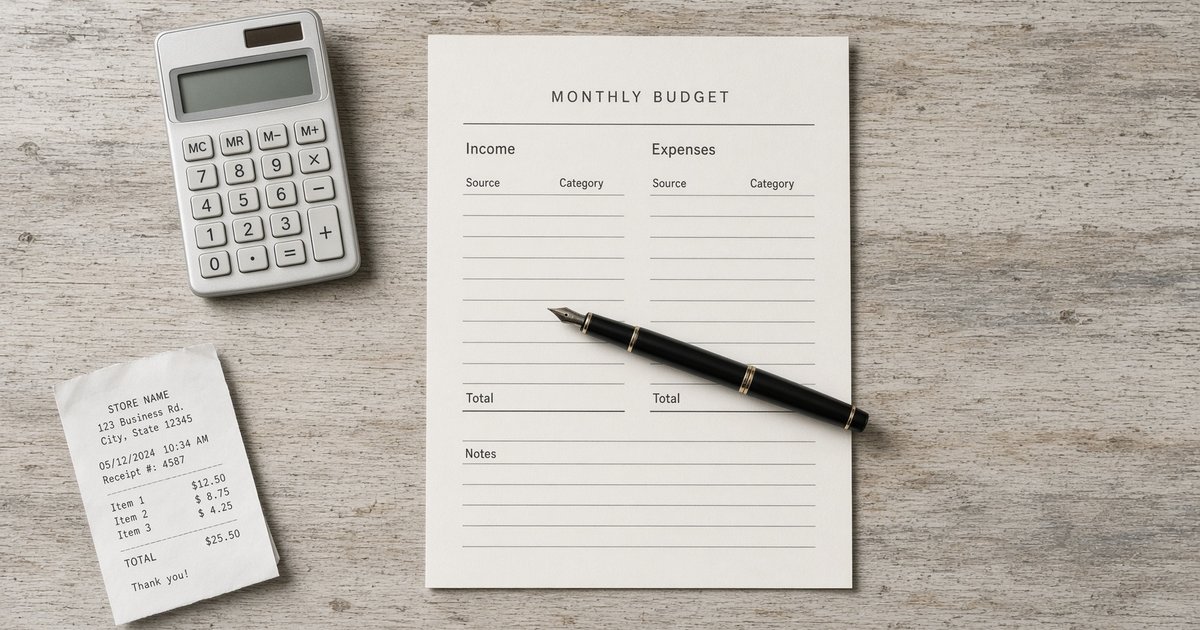
You don’t need software for a first pass — a piece of paper or a blank document works fine. Draw a line down the middle. Label one side “Income,” the other “Expenses.” Pick a time frame; monthly is easiest for most people, since it lines up with rent, salaries, and most recurring bills.
Under Income, list everything landing in your account after tax: salary, freelance work, any regular side income. Under Expenses, list the obvious ones first — rent or mortgage, groceries, transport, utilities, debt repayments, subscriptions. Don’t worry about capturing every last coffee on this first pass. The goal here is a rough, honest picture, not a perfect one.
- List your after-tax income for the month, all sources combined.
- List your fixed expenses — the bills that don’t change much: rent, insurance, loan repayments.
- List your variable expenses — groceries, fuel, eating out, entertainment.
- Add both columns and compare the totals.
What the numbers are telling you
Once both columns are totalled, you’re left with one of two situations, and each one tells you exactly what to do next.
If income comes out ahead of expenses, you’re above water, and the size of that gap is your starting point for savings or debt repayment. If expenses outpace income — even by a small amount — that’s a signal to act on now, before it turns into a larger problem. Neither outcome is a surprise you should feel ashamed of. It’s information, and information is the entire point of doing this exercise in the first place.
If you land in the second category, the next move isn’t to panic-cut everything at once. It’s to go category by category and look for the expenses that can flex without upending your life — which is exactly the territory advanced budgeting techniques is built to cover.
Why writing it down changes behavior
There’s a reason this exercise works even in its simplest form: seeing a number on paper is different from carrying it around vaguely in your head. Behavioral finance researchers call this the difference between “felt” and “known” — most people feel roughly okay about money until they actually know the figures, at which point the feeling either gets confirmed or corrected.
People who track a budget consistently for even a few months tend to report a real drop in money-related stress, not because their income changed, but because uncertainty is often more stressful than the actual number, whatever it turns out to be. Once you know where you stand, you can act. Not knowing just leaves you reacting.
This first budget doesn’t need to be sophisticated. It needs to exist, and it needs to be honest. Everything more advanced — sub-categories, tracking apps, the 5% rule, needs-versus-wants splits — is just refinement layered on top of this same basic habit: know what comes in, know what goes out, and look at both on purpose.