
Quick test: what did you pay for a loaf of bread last time you bought one? A carton of milk? Your usual laundry detergent? Most people can’t answer any of these within a reasonable margin — and that’s true regardless of income, because grocery price awareness has almost nothing to do with how much money you have and everything to do with a habit almost nobody builds.
We research big purchases obsessively. Nobody buys a car from the first dealership they visit — we compare models, check prices across three or four places, and only commit once we’re confident we’ve found a fair deal. Groceries get none of that scrutiny. We buy the same items from the same shop, week after week, and simply accept whatever the price happens to be that day.
We research big purchases and ignore small, repeated ones
The irony is that groceries are exactly the kind of spending where price awareness pays off the most, precisely because it’s repeated so often. A car purchase happens once every several years. A weekly shop happens fifty-two times a year, and the same roughly 80% of items tend to make up the bulk of it — the same bread, the same milk, the same coffee, the same cleaning products, purchase after purchase.
That repetition is what makes price awareness so powerful here. Learning the price of a car you’ll buy once saves you money once. Learning the prices of the dozen or so products that make up most of your regular shop saves you money every single week, for as long as you keep shopping.
The hour that pays you back for years
Building this kind of awareness doesn’t require an app, a spreadsheet, or a subscription to a price-comparison service. It requires roughly one hour of focused attention, spread over a couple of shopping trips, and then it becomes something you simply know — the way you know your own phone number.
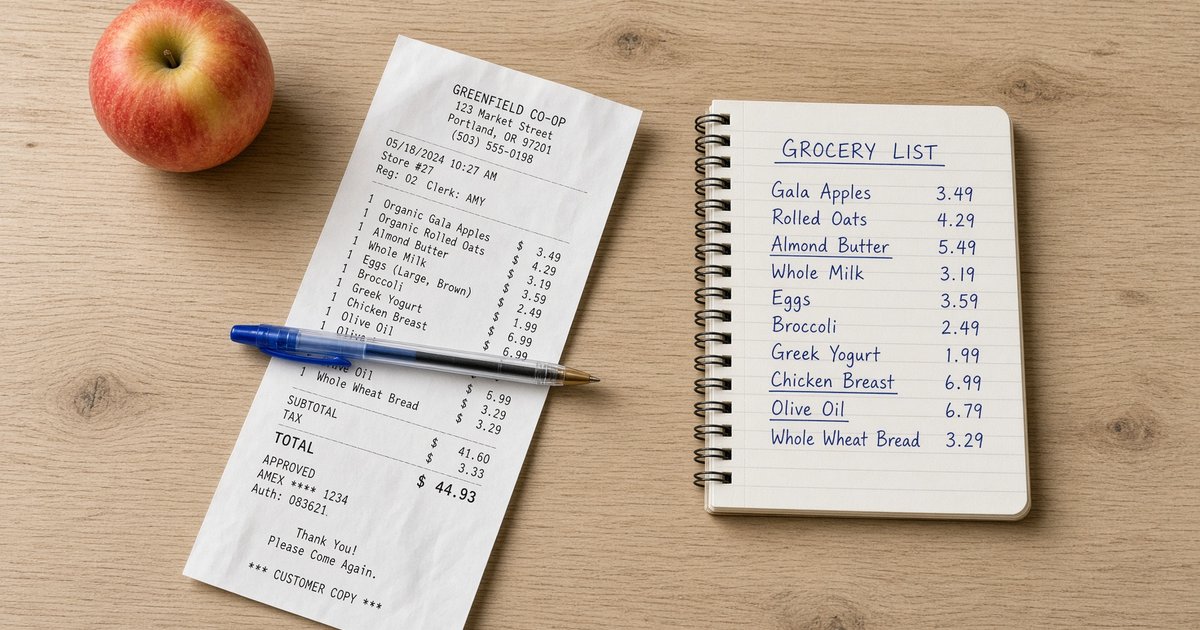
Keep a receipt from your next shop. At home, write down the products you buy regularly, along with the brand, the size or weight, and the price you paid. That’s the raw list. The next step is the part that actually changes anything: committing a handful of those prices to memory, a couple of products a day, until the core of your regular shop is something you can recall without checking a receipt or an app.
Forget scanner apps and price-comparison tools. The goal is knowing the number instantly, without pulling out your phone in the middle of the aisle.
How to actually memorize your core shopping list’s prices
- Keep your next few receipts and write down the regular items, brands, sizes, and prices you paid.
- Pick two or three products a day to focus on rather than trying to memorize the whole list at once.
- Say the price out loud when you pick the item up next time — reinforcement through repetition works faster than passive reading.
- Revisit the list monthly, since prices shift and your memorized figures need the occasional update.
The “selective perception” effect
Something curious happens once you actually know what your usual products cost: you start noticing them everywhere. Adverts, shop windows, mailbox flyers, price tags at a store you don’t normally visit — a specific brand of washing powder you were previously blind to suddenly seems to be advertised constantly. The ads were always there. You just had no reason to register them before, because you had no number to compare them against.
This isn’t about hunting for the cheapest brand available — it’s about knowing where the cheapest price for your usual brand happens to be. Once that awareness kicks in, it’s common to end up buying part of a weekly shop from one store and part from another, simply because you now notice, at a glance, which one is actually charging less for the same product.
Turning price-awareness into real monthly savings
The savings here rarely come from one dramatic discovery. They come from a steady stream of small ones — the detergent that’s £1.20 cheaper two aisles over, the bread that’s on a genuine offer rather than a manufactured “was/now” markup, the brand you’d been buying out of habit even though an identical one nearby costs less. None of these individually feels significant. Across a year of weekly shops, they add up to a meaningful amount.
That saved money doesn’t have to just sit in the current account, either — it’s a natural candidate for debt repayment or a savings pot, the same way any spare margin from your budget can be redirected once you know it exists. If you’re looking for more places like this to trim, our guide to the 5% rule covers exactly that kind of everywhere-a-little search.
Compare that to queuing overnight for a one-time sale discount, or standing in line for an hour for a free promotional item — a huge time investment for a single, non-repeating saving. An hour spent memorizing your regular grocery prices, by contrast, keeps paying you back on every single shop that follows.